Have you ever sat on your porch, watching dark clouds roll in, and felt that sudden, cold knot of worry in your stomach? If you have, you are far from alone. The window to catch your breath between major storms is shrinking fast. In the 1980s, we averaged 82 days between billion-dollar weather disasters. Now, we get a mere 19 days. That means recovery and preparation are practically overlapping.
In 2024, the U.S. endured 27 separate billion-dollar disasters.¹ The following year, 2025, saw another 23 billion-dollar events, with severe convective storms like tornadoes, hail, and high winds making up 21 of them.²
So what does this actually mean for you? It means waiting until a storm is on the radar to get ready is a losing approach. We have to shift from reacting to being ahead of the game. It is about building a buffer of safety before the wind starts howling. Think of it like training for a marathon: you do not wait until race day to start running.
As Morgan Loomis, a disaster recovery expert at Good360, points out, storm season is not the time to start planning. It is time to execute the plan you already have. Planning saves lives, reduces chaos, and helps your family recover much faster.
Fortifying Your Exterior and Securing the Perimeter
Your home is your castle, but even castles need their walls checked before a siege. The exterior of your house is the first line of defense against whatever nature throws your way.
Start at the very top. A roof audit is your best defense against water damage. Walk around your property and look for loose, curling, or missing shingles. If you find any, patch them immediately because even a tiny leak can ruin an entire ceiling during a downpour. Although you are up there, clear out your gutters and downspouts. When gutters clog, water backs up under your roofline or pools around your foundation. That is a recipe for a flooded basement, and it is entirely preventable.
Next, look at your yard. Think of everything loose outside as a potential missile. Those patio chairs, the heavy grill, and even those potted plants can easily shatter a window in 70-mile-per-hour winds. Trim your trees and cut back dead branches that hang over your roof. A single falling limb can cause thousands of dollars in structural damage.
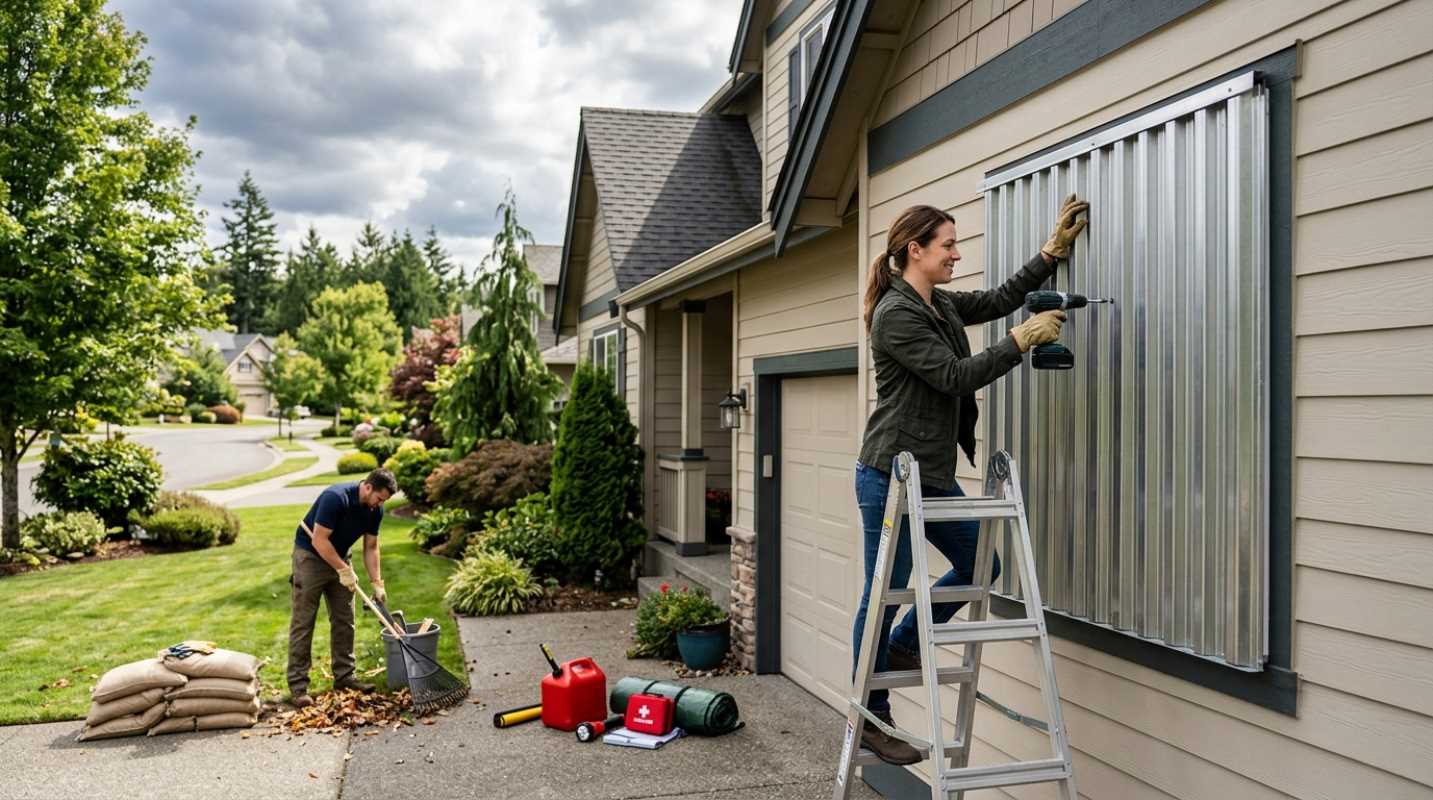
Finally, secure your windows and doors. If you do not have impact-rated windows, pre-cutting 5/8-inch exterior-grade plywood is the gold standard for storm protection. Drill your pilot holes and label each sheet (like "living room left") so you can screw them into place in minutes when a warning drops. Do not forget your garage door either. It is often the weakest point of a house. If strong winds blow it inward, the sudden pressure change can actually lift your roof right off the walls. Consider installing a garage bracing kit to keep it secure.
The Needs and Your Emergency Supplies
When the power goes out and the roads are blocked, you are on your own for a little while. That is why having the right gear on hand is non-negotiable.
You need two distinct setups: a stay-at-home kit designed to keep you comfortable for up to two weeks, and a grab-and-go bag for quick evacuations.
Let us break down what goes into each kit.
For your stay-at-home kit, make sure you have
• Water: One gallon of water per person (and pet) per day.
• Food: A two-week supply of non-perishable, shelf-stable items that do not require cooking.
• Tools: A manual can opener, a multi-tool, and a wrench to shut off your utilities if needed.
• Power and light: LED lanterns, flashlights, and a mountain of fresh batteries.
• Communication: A hand-crank or battery-powered NOAA weather radio.
• Medical needs: A complete first-aid kit and a full month of any important prescription medications.
• Sanitation: Moist towelettes, heavy-duty garbage bags, and plastic ties.
For your go-bag, focus on portability
• Basic nutrition: A three-day supply of high-energy bars and bottled water.
• Tech and cash: Charged power banks, charging cables, and small bills (since card readers fail when the power goes out).
• Safety gear: Whistle, N95 dust masks, work gloves, and sturdy shoes.
• Personal comfort: Emergency space blankets, rain gear, and a change of clothes.
• Specialty items: Diapers and formula for babies, or food, leashes, and vaccine records for your pets.
Keep your key documents, like insurance policies, deeds, and birth certificates, in a waterproof, portable container right next to your go-bag. If you have to run, you can grab everything in one motion.
Interior Safety and Creating a Secure Haven
Preparing your home is not just about the physical structure. It is also about how you and your family behave inside it when things get rough.
FEMA and the American Red Cross always emphasize that preparedness starts at home. They recommend breaking these big safety tasks down into small, manageable chores throughout the year. This approach dramatically cuts down on the anxiety of storm season.
First, identify your safe room. For tornadoes and extreme winds, this is an interior room on the lowest floor, like a closet, bathroom, or hallway, away from windows. Put as many walls between you and the outside as possible.
Next, establish a communication plan. If the cell towers go down, how will you reach each other? Pick an out-of-state contact person everyone can text, as text messages often go through when phone calls fail.
Lastly, run a quick safety sweep. Test your smoke alarms and carbon monoxide detectors, and make sure your fire extinguishers are not expired. When power outages force people to use candles or portable heaters, the risk of home fires spikes dramatically.
Digital and Financial Readiness
Physical prep is only half the battle. The financial aftermath of a storm can be just as devastating as the wind and rain.
Have you actually read your home insurance policy lately? Many homeowners assume they are covered for everything, only to find out too late that standard policies do not cover flood damage. You need a separate policy for that, and it usually has a 30-day waiting period before it kicks in. Do not wait until a storm is spinning in the Gulf to call your agent.
A recent survey showed that while 84% of homeowners faced extreme weather challenges, only 33% made upgrades to protect their properties, often due to cost.³ But digitizing your home inventory is completely free. Just take your phone and do a slow, detailed video walkthrough of every room. Open drawers, film the electronics, and capture serial numbers. Save this video to the cloud. If you ever need to file a claim, this video is your golden ticket to a faster payout.
Also, set up your digital early warning system. Download local weather apps, enable wireless emergency alerts on your phone, and keep a close eye on changing conditions.
To help you get started on your storm preparedness journey, we have compiled a list of top-rated safety gear and home fortification tools.
Building Your Timeline for Action
When a storm is actively heading your way, execution is everything. Having a clear timeline keeps panic at bay.
At the 48-hour mark before a storm, start monitoring local news closely. Charge every phone, laptop, and backup battery in the house. Fill clean plastic jugs with water and freeze them. This keeps your freezer cold longer if the power cuts out and gives you extra drinking water later. Also, fill your car's gas tank because gas stations run out of fuel or lose power quickly.
At the 36-hour mark, secure your exterior. Board up those windows, bring in the patio furniture, and double-check your emergency kits. If local authorities issue an evacuation order, do not hesitate. Unplug your major appliances to prevent surge damage, shut off your main utilities, and leave immediately.
Preparing your home is not a one-time chore you can check off and forget forever. It is an ongoing cycle of maintenance and awareness. But the peace of mind you get from knowing your home and family are secure is worth every bit of effort. Start your checklist today, and face the next storm season with confidence.
Sources:
1. Active Year for U.S. Billion-Dollar Weather and Climate Disasters
https://www.climate.gov/news-features/blogs/beyond-data/2024-active-year-us-billion-dollar-weather-and-climate-disasters
2. 2025 in Review
https://www.climatecentral.org/climate-matters/2025-in-review
3. Homeowners Guide to Extreme Weather
https://www.hippo.com/blog/homeowners-guide-to-extreme-weather
*This article on tenlira is for informational and educational purposes only. Readers are encouraged to consult qualified professionals and verify details with official sources before making decisions. This content does not constitute professional advice.*



.png)