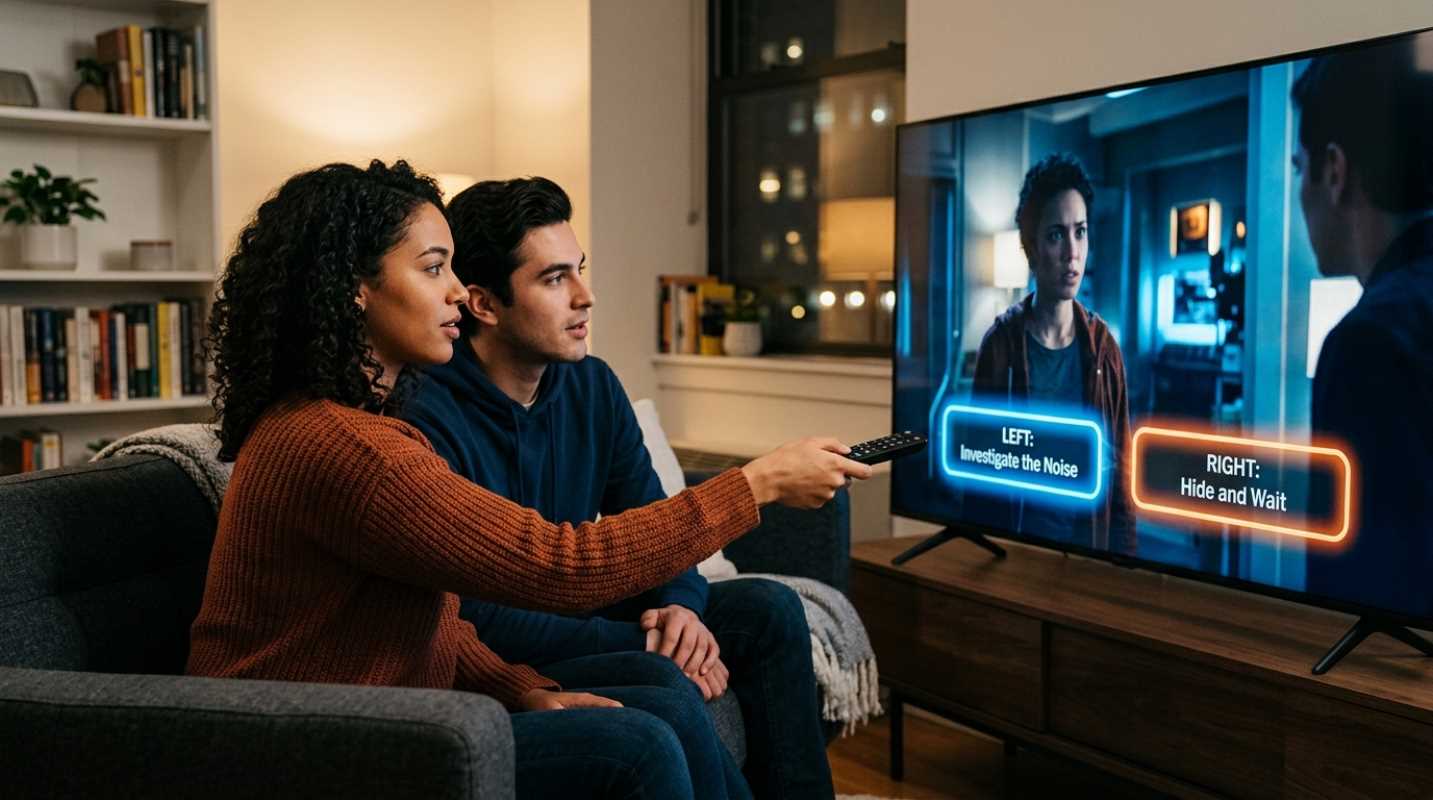
Remember the last time you sat on the couch, remote in hand, yelling at a character not to open that creepy basement door? We have all been there. You knew it was a terrible idea, but you were completely powerless to stop it.
For decades, watching television was a one-way street. You sat down, the screen turned on, and you consumed whatever the writers decided to feed you. Today, that passive relationship is fading fast.
We are living in an era where streaming media is transforming from a spectator sport into an active experience. This shift is the next major evolution of entertainment, driven by technology that has finally caught up to our creative ambitions.
The Mechanics of Branching Narratives
How do you build a show where the viewer actually calls the shots? It is a massive technical challenge. Behind the scenes, creators must map out incredibly complex decision trees.
If you decide a character should run left, the platform has to load that video stream instantly. If you choose right, a completely different stream must play. The magic lies in making these transitions so seamless that you never see a buffering wheel.
There is also a delicate creative balance at play. Writers must give you genuine agency while keeping the overall story coherent and high-quality. If your choices do not feel like they matter, you will get bored. If the plot falls apart because of a weird choice, you will turn it off.
To solve this, creators use state tracking. The streaming software remembers your past choices, like whether you picked up a key in scene two, and uses that information to unlock specific dialogue options in scene eight. It is a complex web of code disguised as a cinematic movie.
Why Viewer-Driven Plots Are Resonating with Modern Audiences
Why are we so obsessed with making these choices? It comes down to psychology. In a digital world where we customize everything from our music playlists to our coffee orders, we expect our stories to be personalized too.
The global market for interactive storytelling platforms reached 2.14 billion dollars in 2024 and is projected to hit 11.98 billion by 2033.¹ This massive growth is heavily driven by younger viewers who demand active participation over sitting back and watching.
When you make a choice that leads to a character's demise, you feel a level of personal guilt and emotional connection that traditional TV just cannot replicate. You are no longer just an observer. You are an accomplice.
This format also creates incredible replay value. You and your friends can compare notes, discover entirely different endings, and immediately head back to replay the story to see what you missed. It turns a solitary viewing experience into a social event.
From Niche Experiment to Mainstream Staple
You might remember the early days of this trend. Netflix made waves with Black Mirror: Bandersnatch. But the interactive space has shifted dramatically over the last couple of years.
Surprisingly, Netflix decided to step back from its original choose-your-own-path format. Between late 2024 and mid-2025, the streaming giant systematically removed almost its entire interactive catalog, including Bandersnatch.² They decided that solitary branching-video tech was too limiting and shifted their focus to mobile and cloud gaming instead.²
So, is interactive TV dead? Not even close. It just evolved.
Instead of one person clicking a remote alone, we are seeing the rise of Massively Interactive Live Events. Take the series DC Heroes United, which launched in late 2024.³ Every week, millions of viewers collectively voted on important decisions that permanently shaped the DC canon.³
This interactivity is even spilling over into your commercial breaks. Brands are using the same technology to make advertisements you actually want to watch.
Like, Audi India launched an interactive smart TV campaign where viewers used their standard remotes to customize a car's color in real-time and explore the interior. The campaign was a massive hit, earning over 2.8 million household impressions and proving that people actually want to engage with their screens.
If you want to see how these formats look in action, consider these popular styles
• Interactive Ads, Viewers use their standard TV remotes to customize products on screen, like changing a car's color during a commercial.
• Community Voting, Millions of players vote together to decide the fate of major characters in weekly episodes.
• Gamified Storytelling shows that blend traditional viewing with light gameplay mechanics to keep younger audiences engaged.
If you want to experience the best of what interactive media has to offer today, here are a few top platforms and shows to check out.
The Future of Immersive Content
Where do we go from here? The next few years will likely be defined by artificial intelligence.
In late 2025, Disney announced a historic 1 billion dollar partnership with OpenAI to integrate advanced generative video and AI tools. This means we might soon see streaming platforms where you can prompt and generate your own customized Disney or Marvel stories on the fly.
With AI-assisted authoring tools, creators can build complex branching paths ten times faster and cheaper than before. This will inevitably disrupt traditional episodic television.
We are moving toward a future where a show is not a static piece of art, but a living, breathing sandbox. The interactive revolution is here to stay, and the only question left is: what choice will you make next?
Sources:
1. Growth Market Reports
https://growthmarketreports.com/report/interactive-storytelling-platforms-market
2. IGN
https://www.ign.com/articles/netflix-to-remove-black-mirror-bandersnatch-from-platform-in-an-effort-to-ditch-interactive-programming
3. DC
https://www.dc.com/games/dc-heroes-united-2024