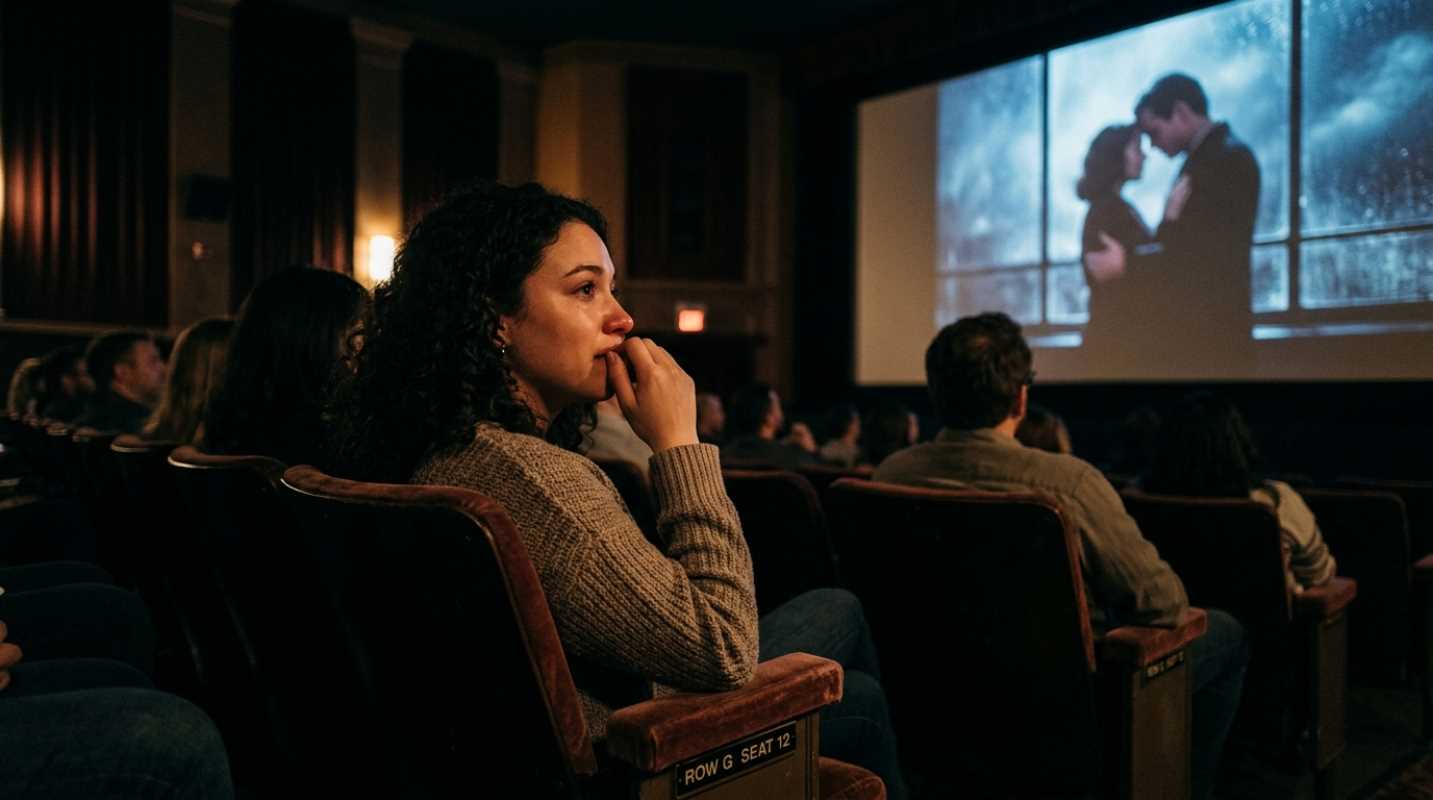
Have you ever tried watching your favorite thriller on mute? It's a bizarre, almost comical experience. The killer creeps up behind the victim, but without that rising screech of violins, the tension completely evaporates. It turns out that movie music isn't just background noise designed to fill the silence. It's the invisible architect of the entire cinematic experience, building the emotional walls and corridors of the story without you ever realizing it.
When you sit in a dark theater, the score functions as a psychological anchor. It tells your brain exactly how to interpret the images on the screen. If you see a man walking down a quiet street, the music decides whether he's a peaceful citizen heading home or a target being stalked by a predator.
This wasn't always the case. In the early days of cinema, silent films relied on live piano players or organists. Their primary job was simple: drown out the incredibly loud, clanking movie projectors. Over the decades, this basic accompaniment evolved into the massive, immersive soundscapes we hear today. Modern composers don't just write tunes. They build complex auditory environments that wrap around you, pulling you directly into the characters' inner worlds.
Musical Storytelling: The Language of Emotion
How does a filmmaker show you what a character is thinking when they don't say a word? They let the music do the talking. This is the art of musical storytelling, and it relies heavily on a clever tool called the leitmotif. A leitmotif is a recurring musical theme tied to a specific character, place, or concept. Think of the ominous two-note cue for the shark in Jaws, or the heroic brass fanfare that announces Indiana Jones.
These themes do more than just announce a character's arrival. They can actually change how you remember the story itself. A study from the Georgia Institute of Technology showed that music acts like an emotional time machine.¹ The researchers had participants recall difficult personal memories while listening to different movie soundtracks. They found that the emotional tone of the music permanently altered how the participants remembered those events, even when they recalled them the next day in total silence.
In a movie, a composer can use this exact trick to manipulate your memory of earlier scenes. If a composer plays a character's heroic theme but twists it into a slow, tragic key, it retroactively reshapes how you feel about that character's happier beginnings.
Dr. Juan Chattah, a professor of music theory at the University of Miami, highlights this beautifully in his work on cognitive film music. He points to the song "The Hanging Tree" from The Hunger Games. What starts as a quiet, whispered melody sung by Katniss gradually transforms into a massive, orchestral protest anthem. The music draws you closer to her, turning a simple tune into a tool for rebellion while giving the entire narrative a heavy, historical weight.
Emotional Cinematography Painting with Sound
We often think of cinematography as a purely visual art, but there's a powerful teamwork between visual framing and auditory cues. In many ways, the soundtrack is a form of emotional cinematography. It dictates the pacing, controls the flow, and shapes the "feel" of a scene.
Even more surprisingly, the music actually tells your eyes where to look. A study from the Sapienza University of Rome proved this by tracking the eye movements of people watching an emotionally neutral film scene set to different soundtracks. The results were striking
• The Anxious Soundtrack: When viewers listened to a tense, anxious piece by Sergei Rachmaninov, their bodies went into high alert. Their pupils dilated, and they spent more time scanning the frame for potential threats, which actually caused them to notice tiny, hidden background details that others missed.
• The Melancholic Soundtrack: When viewers listened to a gentle, melancholic jazz piano solo by Bill Evans, their alertness dropped. They focused almost entirely on the character's face, feeling more empathy for him and viewing him as a softer, more introverted person.
This means the score acts as an invisible co-director. By using sonic dissonance (harsh, clashing sounds) or harmony, a composer can force your eyes to search the screen in panic or relax into a character's emotional journey.
Why We Remember the Music Long After the Credits Roll
Have you ever heard a specific chord progression on the radio and instantly flashed back to a scene from a movie you saw ten years ago? This auditory flashback is a powerful cognitive phenomenon, and it explains why soundtracks become the ultimate identity of a film in pop culture.
Our brains are wired to prioritize emotional memories, but this comes with a fascinating trade-off. A study published in The Journal of Neuroscience looked at how classical music shapes memory after an experience.² The researchers found that highly emotional music creates a memory trade-off. If a piece of music triggers high emotional arousal, you remember the big picture (the "gist" of the scene) incredibly well, but you lose the fine details. If the music is only moderately moving, you remember the specific visual details much better.
So when a movie climaxes with a massive, tear-jerking orchestral score, your brain is busy locking in the emotional core of the story. You might forget what color shirt the main character was wearing, but you'll remember the feeling of that scene forever.
But why is this emotional memory so incredibly durable? Another study, published in Nature Human Behavior, used advanced brain imaging to show that high emotional arousal acts like a master glue for the brain.³ It strengthens the connections across sensory, cognitive, and emotional brain networks that usually work separately. This coordinated state makes emotional memories incredibly "sticky."
On top of that, the music literally synchronizes the brains of the entire audience. Researchers at King's College London scanned people's brains while they watched Forrest Gump. They discovered that the acoustic features of the soundtrack matched up with shared emotional ups and downs across different viewers. The music triggers matching activity in key brain hubs, like the superior temporal sulcus and the precuneus, aligning everyone's neural responses. The soundtrack makes sure that a theater full of strangers experiences the exact same emotional peaks at the exact same millisecond, creating a unified, collective memory.
The Future of Sound Innovation in 2024 and Beyond
As we look at modern cinema in 2026, technology is changing how composers build these sonic worlds. Modern production tools allow for incredible experimentation, but the fundamental goal of the score hasn't changed.
Today, we see an interesting balance in modern cinema
• The Minimalist Approach: Composers use quiet, droning synths or single, isolated instruments to create space, forcing the audience to sit with their own thoughts and focus on the raw acting.
• The Maximalist Approach: Massive, hybrid orchestral arrangements blend traditional instruments with electronic textures to create a lot of, larger-than-life sensory experiences.
Whether a film uses a whisper of a piano or a thunderous wall of sound, the auditory experience remains the true heart of cinema. It's the secret ingredient that turns moving pictures into lasting memories, making sure that long after the screen goes dark, the story stays alive in your mind.
Sources:
1. Georgia Institute of Technology
https://psychology.gatech.edu/news/georgia-tech-neuroscientists-explore-intersection-music-and-memory
2. Rice University
https://studyfinds.com/how-music-tunes-your-memory/
3. University of Chicago
https://datascience.uchicago.edu/insights/new-research-explores-what-makes-emotional-memories-stick/